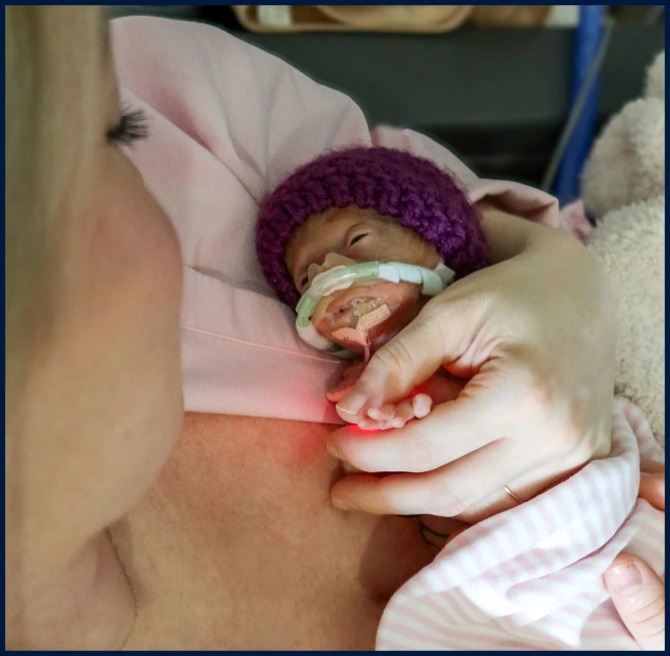
Meet Violet
Born premature and, like millions of infants each year, dependent on CPAP support to breathe. Her story is common, and so are the complications caused by the interface delivering her care.
A brighter tomorrow starts today.
Osos Medical builds devices for the NICU's smallest patients. Our first product, the PNOIA System, is a next-generation CPAP interface for premature infants that combines the therapeutic reliability clinicians depend on with the comfort and simplicity they've been asking for.
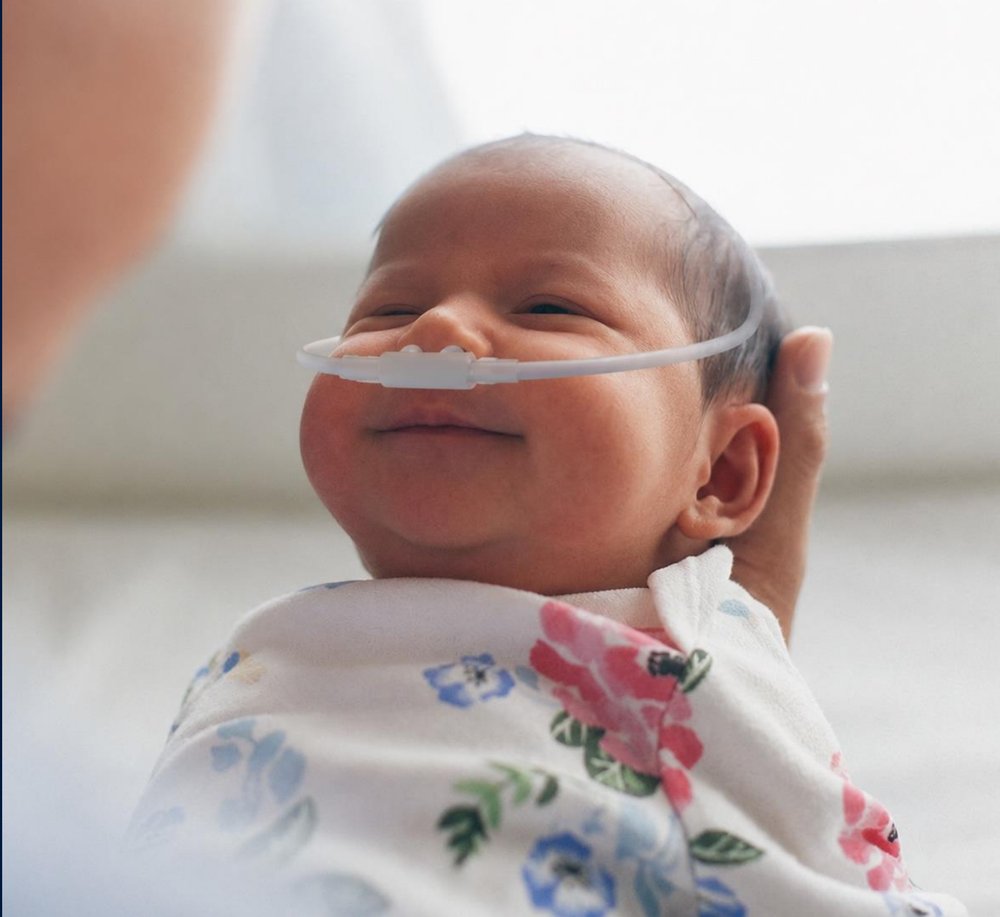
The Problem
Born premature and, like millions of infants each year, dependent on CPAP support to breathe. Her story is common, and so are the complications caused by the interface delivering her care.
Water condenses in the tubing and drips toward the airway. Clinicians must repeatedly stop therapy to clear it, causing dangerous pressure drops.
Bulky masks shift easily during routine care, especially when infants lie on their stomachs. Nurses often notice a broken seal only once a baby's heart rate drops.
Intranasal prongs press continuously on the immature nasal septum. Once damaged, that tissue doesn't regenerate and can require reconstructive surgery later in life.
The tight securement masks need to hold a seal contributes to midface (maxillary) hypoplasia, a long-term facial-growth deformity.
Even experienced clinicians can misapply current devices, adding risk in already understaffed NICUs.
Clinicians often move infants to lower-support interfaces early to avoid these complications, despite much higher failure rates, raising the risk of lung disease and longer NICU stays.
"My nurses do frequent rounds to check for condensation, but my patients are still aspirating on water."Neonatologist
"Masks are frequently dislodged, particularly when infants are on their stomachs, which can cause drops in heart rate."NICU Nurse
"My customers have been asking me: why aren't my patients getting better?"Medical Device Distributor
Our Solution
A modular neonatal CPAP platform. One shared tubing and connection port lets clinicians swap between soft nasal pillows and a mask as an infant's needs change, with no new system to set up.
Designed to spare the fragile nasal septum from the constant pressure of legacy prongs.
A secure, low-profile fit that holds through routine care and prone positioning.
Mitigates tissue breakdown and the maxillary deformation linked to tight mask securement.
Makes repositioning easier for infants and the clinicians caring for them.
Decreases air turbulence and the risk of condensation reaching the airway ("dry drowning").
An adjustable adhesive fit makes application quicker and more consistent.
The PNOIA System is in development and not yet FDA cleared. A provisional patent application is on file, a working prototype is built, and NICU benchtop testing is underway.
Market Opportunity
CPAP nasal injury is a persistent, well-documented problem: one 2026 study found it in about 1 of every 250 device-days, 83.5% of them within the first three days of use, pointing to interface design rather than clinician technique as the fix. Meanwhile more of the smallest babies are surviving, so the need keeps growing.
Pursuing FDA 510(k) clearance as a Class II device via the substantial-equivalence pathway, with biocompatibility and ISO testing planned ahead of submission.
Partnering with NICU clinical sites on early pilot programs to generate real-world outcomes data ahead of commercial launch.
Direct engagement with procurement departments and distributors, informed by our neonatology and respiratory therapy advisors.
Competitive Landscape
Current options force clinicians to choose between therapeutic efficacy and patient comfort. The PNOIA System is designed to deliver both.
| Device | Effective CPAP pressure | Low profile / prone-friendly | Condensation control | Septum & skin safety | Swap interfaces, same system | Simple application |
|---|---|---|---|---|---|---|
| FlexiTrunkFisher & Paykel | ✓ | ✕ | ✕ | ✕ | ✕ | ✕ |
| Hudson Nasal ProngsTeleflex | ✓ | • | ✕ | ✕ | ✕ | • |
| RAM CannulaNeotech | ✕ | ✓ | ✕ | • | ✕ | ✓ |
| PNOIA SystemOsos Medical | ✓ | ✓ | ✓ | ✓ | ✓ | ✓ |
In a study of 118 preterm babies on nasal CPAP, 90.7% developed nasal skin injury, most within the first two days (Pascual & Wielenga, 2023).
The Team

Cal Poly biomedical engineer (2026) and Edwards Lifesciences alum. Leads clinical strategy, partnerships, fundraising, and the path to market.

Cal Poly mechanical engineer (2026) with device R&D experience at Stryker and Abbott. Leads product engineering and the design of the PNOIA System.

Work with us
We're seeking strategic partners, clinical collaborators, and early-stage investors.
[email protected]